Showing posts with label Germany. Show all posts

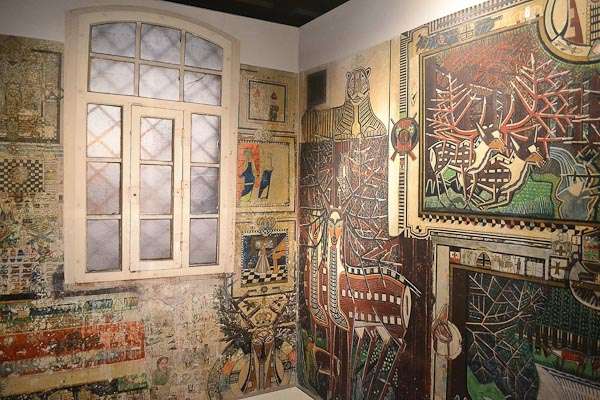
Julius Klingebiel Zelle (Göttingen/ Germany)

Julius Klingebiel Zelle (Göttingen/ Germany)

The artwork covering the walls of this psychiatric hospital cell is that of Julius Klingebiel (1904-1965). The former German army mechanic was arrested in 1939 for killing his step son and shortly after got diagnosed with paranoid schizophrenia and was hospitalized.

Soon he began decorating the cell where he stayed, at first using a paste made from toothpaste, coal, wood and stone. When the nursing staff noticed the calming effect he got from painting they supplied him with proper paint and a brush which he used to cover all the walls of cell #117. The paintings featured animals, (military) people, ships, heraldic motives, national-socialist topics and roman-catholic imagery.

After his death in 1965 the hospital preserved his cell as it was. Only a handful of people knew about it until the artworks were published in a book as part of a research project in 2013 and the cell is now protected by law as a cultural monument.
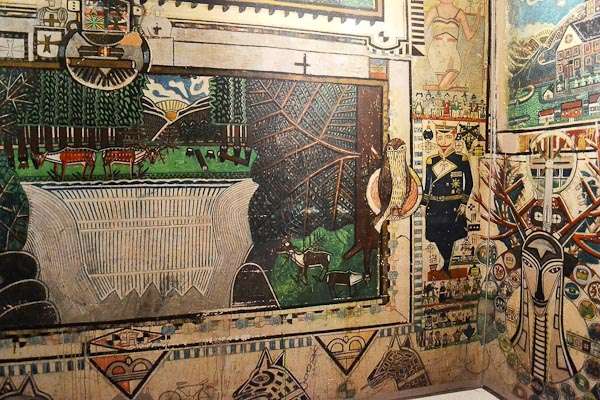
Julius Klingebiel Zelle (Göttingen/ Germany)

Lichtenstein Castle (Honau/ Germany)


Lichtenstein Castle is situated on a cliff near Honau on the Swabian Alb, Baden-Württemberg, Germany.
There has been a castle on the site since around 1200. It was twice destroyed around 1300 and fell to ruin.
In 1802, the land came into the hands of King Frederick I of Württemberg, who built a hunting lodge there. His nephew Duke Wilhelm of Urach, Count of Württemberg added the current castle in 1840–42. The romantic Neo-Gothic design of the castle was created by the architect Carl Alexander Heideloff.
Today, the castle is still owned by the Dukes of Urach, but is open to visitors. The castle contains a large collection of historic weapons and armour.

Cosmic Greenhouse (Germany)


“Cosmic Greenhouse” is an abandoned series of dome- shaped greenhouses.
They're somewhere in Germany but the exact location is not revealed by the urban explorer who took the photos, probably to protect the place from vandalism.

Baumhaus Solling (Uslar/ Germany)


This two-storey treehouse tower in a pond was designed by Baumraum for a family in Lower Saxony, Germany. The main space is accessable by stairs from the water's edge and another exterior stairway leads to the upper sleeping area.
During the day, the treehouse serves as a vantage point for observing fish & frogs in the water and deer grazing on the adjoining meadows. At night you can gaze at the stars through the domed skylight in the sleeping area.

V8 Hotel (Stuttgart/ Germany)


Stuttgart's V8 Hotel is the perfect place for car enthusiasts!
The 4-star hotel is located on a former airport site in the auto museum "Böblingen’s Meilenwerk". It features many car themed rooms in which you'll find legendary vintage cars, sporty young timers, as well as exclusive & special classic cars.

Baumraum's World of Living Tree House (Rheinau-Linx/ Germany)


This amazing treehouse on skinny spider legs was created by Baumraum - is located at World of Living , a showspace/amusement park for sustainable housing company "WeberHaus".

"The vaulted interior welcomes visitors with wallpaper depicting giant oak leaves as if the house itself were a tree. In fact, the walls are all made of native oak. Tired guests can take a load off in rotating seats, and integrated roll cages and drawers can act as tables or storage. Two skylights and large windows daylight the space and allow views in all directions over the park and into the tree crown."

Base Camp Bonn Young Hostel (Bonn/ Germany)


15 various vintage camping caravans, two former railway Pullman coaches and four used U.S. Airstream trailers is what you sleep in at the Base Camp Bonn Young Hostel. The trailers were individually designed by film and TV outfitter Marion Seuland prices range from 22 to 69 euro per night.

Hundertwasser-Kuchlbauer Tower (Abensberg/ Germany)


The Kuchlbauer Tower is an observation tower designed by Austrian architect Friedensreich Hundertwasser - who died in the year 2000 during the tower's planning phase - and completed 10 years later under the direction of Leonhard Salleck, owner of the Kuchlbauer brewery.

Giant Lego Bridge (Wuppertal/ Germany)


Street artist Megx converted a bridge in Wuppertal, Germany into a giant Lego structure using colored panels that create the illusion of being the underside of Lego bricks. The bridge itself is part of an old train line that has been converted to a pedestrian and cycle path.

AquaDom (Berlin/ Germany)


The AquaDom in Berlin is a 25 metre tall cylindrical acrylic glass aquarium with built-in transparent elevator. It is located at the Radisson Blu Hotel in Berlin-Mitte.

Rainbow Staircase (Wuppertal/ Germany)


The Holsteiner Stairs in Wuppertal got a rainbow makeover by artist Horst Gläsker, who painted them and then stencilled words related to human relationships on the 112 steps, such as terror + love, prosecution + trust, despair + hope, revenge + kiss.

Upside-down house (Trassenheide/ Germany)


The Trassenheide Upside-Down House was created by Polish architects Klaudiusz Golos and Sebastian Mikiciuk as part of the project 'The World Upside Down' which allows visitors a different view of every day items. Since the whole interior is upside-down and can disorient some, the house is used purely as an exhibit.

Kunsthofpassage Funnel Wall (Dresden/ Germany)


When it rains in Dresden, the funnels and pipes that grace this building play "rain-music".

Waldspirale (Darmstadt/ Germany)


The Waldspirale is a residential building complex in Darmstadt, Germany, built in the 1990s. The name translates into English as forest spiral, reflecting both the general plan of the building and the fact that it has a green roof. It was designed by Austrian artist Friedensreich Hundertwasser.

Das Junkerhaus (Lemgo/ Germany)


The Junkerhaus is the creation of architect, artist and wood-carver Karl Junker (1850-1912) who lived there until his death. The house is covered with pilaster and cornices made of carved boards, strips of wood and latticework. The ornamental exterior extends into the interior of the house. The furniture, carvings and approximately 900 drawings and sketches preserved here are the evidence of the creativity and art work of Junker.

Propeller Island City Lodge (Berlin/ Germany)

SYMBOL ROOM:
Photo Sharing and Video Hosting at Photobucket

"This is an extraordinary location. All rooms and objects were created by the German artist Lars Stroschen. Much more appropriate than "hotel" is the designation "living in a work of art". 30 rooms with an absolutely unique and personal ambience. "Unique" is meant literally, for the entirety of all furnishings and other objects you will discover here are custom-made, individual handiwork. None can be found anywhere else on this planet - one could consider the CITY LODGE to be a MUSEUM with guest accommodations or a stay-in work of SCULPTURE. The rooms are designed and constructed without compromise, varying from the tame to the extreme, and provide the opportunity to more or less alter your perspective of reality - according to your taste and sense of adventure."

Neuschwanstein Castle (Hohenschwangau/ Germany)


Neuschwanstein Castle is a 19th-century Gothic Revival palace on a rugged hill above the village of Hohenschwangau in southwest Bavaria, Germany. The palace was commissioned by Ludwig II of Bavaria as a retreat and as an homage to Richard Wagner.
The palace was intended as a personal refuge for the reclusive king, but it was opened to the paying public immediately after his death in 1886. Since then over 60 million people have visited the Castle.
The palace has appeared prominently in several movies and was the inspiration for Disneyland's Sleeping Beauty Castle.

Related Posts Plugin for WordPress, Blogger...