Showing posts with label Italy. Show all posts

Bosco Verticale - Vertical Forest (Milan /Italy)

Bosco Verticale - Vertical Forest (Milan /Italy)

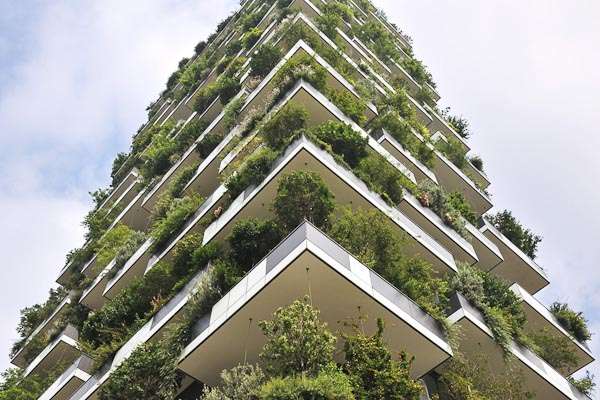
Bosco Verticale (Vertical Forest) is a pair of award- winning residential towers in the Porta Nuova district of Milan. It opened in 2014 and was designed by Boeri Studio.
The towers are home to 900 trees and over 2,000 plants ranging from shrubs to flowers distributed in relation to the façade’s position towards the sun.

The Tower of Peretti (Tuscany/ Italy)


This magnificent fantasy-like fireplace was cast after one of the giant's heads in the Baroque 16th-century Bomarzo gardens. It belongs to the Tower of Peretti. Originally it was built by Spanish invaders as a watchtower & military lookout on the steep and craggy cliffs of Southern Tuscany in the 16th-century.
At the time when these photos were taken it was (and probably still is) the holiday retreat of jewelry designer Elsa Peretti who hired Milanese architect Renzo Mongiardino to turn the awkward and spartan interiors with their thick stone walls, cell-like rooms and cracks for windows into welcoming spaces and to create the illusion of living in a three-dimensional fairy tale tower.

Villa Sbertoli - Abandoned Psychiatric Hospital (Pistoia/ Italy)


The wall mural depicts a scene among ancient ruins and today the very building that houses it has also fallen into a state of disrepair.

Villa Sbertoli was built in the early 1800s by wealthy merchant Agostino Sbertoli. According to some sources he decided to turn the villa into a psychiatric hospital because he had a disabled son, whom he tried to cure all his life. On his death bed he decided to devote all his possessions to a charity for the mentally ill, even their, so that his son could feel at home. It was inaugurated as a psychiatric hospital in 1868.

During World War II it was used by the Nazis to hold prisoners but afterwards was sold to the province and used as a psychiatric hospital again. In 1978 "Law Basaglia" (a reform of the Italian psychiatric system) was passed and the hospital was forced to close and by 1990 was abandoned completely. Today it's still semi-abandoned but the city of Pistoia is attempting to revitalize the area.


Toledo Metro Station (Naples/ Italy)


The Toledo Metro Station opened in September 2012 was designed by the Spanish architect firm Oscar Tusquets Blanca. It is 50 meters deep and mostly themed around water and light.
The artwork inside includes two mosaics by the South African artist, William Kentridge, as well as Light Panels by Robert Wilson and works by Francesco Clemente, Ilya and Emilia Kabakov, Shirin Nehsat and Oliviero Toscani.

Villino Ruggeri (Pesaro/ Italy)


Located on the beach front of seaside town Pesaro (at Piazzale della Libertà) Villino Ruggeri is an extraordinary gem of Italian Art Nouveau or Stile Liberty as they call it there.
It was built between 1902 and 1907 by architect Giuseppe Brega for pharmaceutical industialist Oreste Ruggeri.

The exterior is covered with decorations inspired by plants and the marine world - even lobster eave brackets!
The original outer gate was destroyed in 1936 when Ruggeri, despite the artistic value of the structure, was forced to donate iron to the country.
Today the house is a private residence.

La Scarzuola (Montegabbione/ Italy)


La Scarzuola is the surreal dream palace of Milanese architect & artist Tomaso Buzzi. Originally a Franciscan monastery it was greatly expanded when he bought it in 1956.
The architectural style mirrors several eras, a mix of Classical, Medieval & Renaissance. Surreal artists like Dali, Miro and M.C. Escher have also inspired the architect while creating these structures that reflect his inner thoughts and philosophies.
After his death in 1981, his nephew continued work on La Scarzuola until he completed his uncle's vision.

The Forgotten Palazzo (Milan/ Italy)


After standing empty for at least 50 years Giorgio Armani used this 17th-century apartment as a showroom. While renovating he stripped the apartment’s floors & walls to surprisingly find bright marble Venetian terrazzo and colourful frescoes covered up with paint, which he had restored to their former glory.

Castello di Sammezzano (Reggello/ Italy)


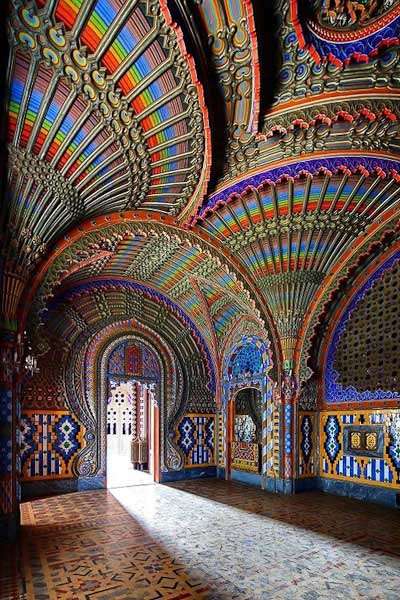
The extravagant residence Castello di Sammezzano sits on top of a hill in Tuscany, Central Italy. Originally it was built in the Moorish style in 1605 for Ximenes d'Aragona and then re-designed between 1853 and 1889. After the war the castello was used as a luxury hotel until closure in the mid to late 1990's. It was abandoned until April 2012 when the FPXA committee was formed, aiming to promote and enhance the castle.

Colourful tower houses on Liguria's coast (Italy)


The coast of Liguria is framed by little villages with colourful tower houses such as
Riomaggiore (photo 1&2), Manarola (3-5) and Vernazza (6).

Cimitero dei Cappuccini (Rome/ Italy)


Cimitero dei Cappuccini: The Crypt - Rome, Italy
The crypt is located just under Santa Maria della Concezione, a church commissioned by Pope Urban XIII in 1626. The pope's brother, Cardinal Antonio Barberini, who was of the Capuchin order, in 1631 ordered the remains of thousands of Capuchin friars exhumed and transferred from the friary Via dei Lucchesi to the crypt.

The Temples of Damanhur (Valchiusella/ Italy)


"Nestling in the foothills of the Alps in northern Italy, 30 miles from the ancient city of Turin, lies the valley of Valchiusella. Peppered with medieval villages, the hillside scenery is certainly picturesque. Here, 100ft down and hidden from public view, lies an astonishing secret - one that has drawn comparisons with the fabled city of Atlantis and has been dubbed 'the Eighth Wonder of the World' by the Italian government.

For weaving their way underneath the hillside are nine ornate temples, on five levels, whose scale and opulence take the breath away.Constructed like a three-dimensional book, narrating the history of humanity, they are linked by hundreds of metres of richly decorated tunnels and occupy almost 300,000 cubic feet - Big Ben is 15,000 cubic feet.Few have been granted permission to see these marvels.Indeed, the Italian government was not even aware of their existence until a few years ago.

But the 'Temples of Damanhur' are not the great legacy of some long-lost civilisation, they are the work of a 57-year-old former insurance broker from northern Italy who, inspired by a childhood vision, began digging into the rock...."

Cave dwellings (Sassi di Matera / Italy)


This awesome place in the town of Matera in the region of Basilicata, Italy, is carved out from the soft tuff rock mountain (sassi = rocks). In 1952 the inhabitants were forcefully relocated by the government due to breakdown of the dwellings' complicated ecosystems and lack of sanitary systems, but that's changing now that they have entered Unesco's World Heritage list (1993). One of the main reasons for the inclusion on the list is the enormous rainwater collection system, another reason is of course the age - the oldest inhabited parts date from the Palaeolithic period, and are thought to be among the first human settlements on the entire peninsula. Several caves have been carefully restored, parts as museum, but most as proper homes, or as holiday homes, small businesses, hotels, and B&Bs.

The conic "Trulli" dwellings in (Apulia / Italy)


Related Posts Plugin for WordPress, Blogger...